← Back to the 3D site Text version 2D site
Case study · Mar 2026 – present
ProofMode: prove the process, don’t guess the author
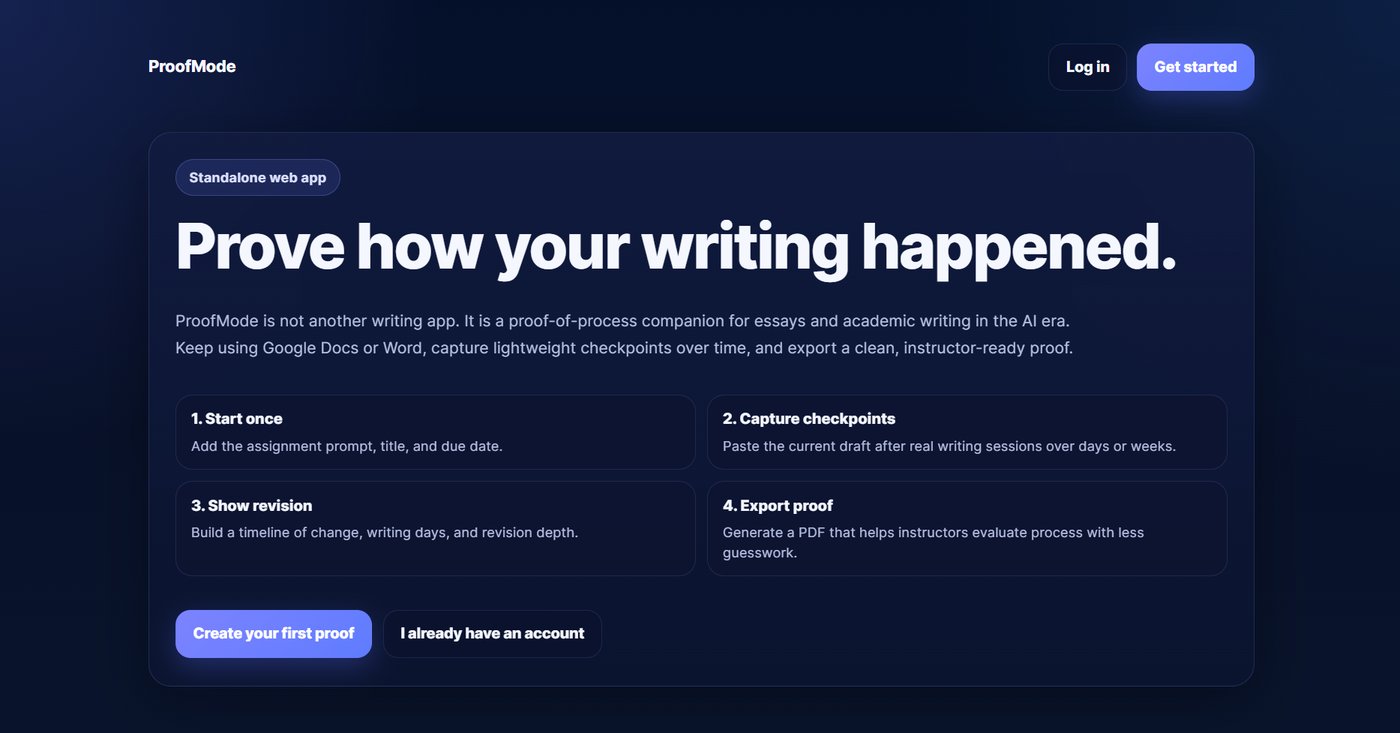
Students keep writing in Google Docs or Word and save lightweight checkpoints in ProofMode as they go. ProofMode turns those checkpoints into a PDF evidence summary with an integrity stamp, so instructors can see how a paper actually came together instead of trusting an AI detector’s guess.
- Recognition2nd Place, UMW Eagle Egg Pitch
- StatusLive at app.proofmode.co
- My roleDesigned and built it, from idea to live product
- StackNext.js 14 · FastAPI · PostgreSQL · Docker
The problem
AI-detection tools look at a finished essay and guess whether it “looks like” AI. That’s an arms race: detectors are easy to fool with light editing, and when they’re wrong, honest students are the ones who get accused. A guess after the fact is a weak foundation for academic integrity decisions.
The idea: proof of process
AI detection
Analyzes the final text after it’s submitted. Produces a probability. Can be spoofed, and gives an honest student no way to show their work.
ProofMode
Records the writing process as it happens: timestamped checkpoints, revision metrics and reflection notes, saved in a record the student chooses to share.
How it works
- Start once. Add the assignment prompt, title and due date. Templates cover common humanities and business assignments.
- Capture checkpoints. After real writing sessions, over days or weeks, paste in the current draft. Each checkpoint is timestamped with character-change metrics, and students can add short reflection notes explaining their choices.
- Show revision. ProofMode builds a timeline of change: writing days, how the draft grew and how deeply it was revised.
- Export the proof. The server generates a PDF evidence summary with up to five recent checkpoints, reflection notes, revision metrics and an integrity stamp that helps instructors evaluate the process with less guesswork.
- Share on the student’s terms. A revocable link (
/s/{token}) gives the instructor access, and the student can turn it off at any time.
Architecture
Security and privacy by design
Student writing is personal, so security was a requirement from the start, not an add-on:
| Passwords | Hashed with Argon2, a modern memory-hard algorithm. |
|---|---|
| Sessions | Signed JWTs in cookies, with CSRF protection on every request that changes data. |
| Essay text | Field-level encryption with Fernet before it’s stored, so the database never holds readable essays. |
| Sharing | Revocable, token-based links: the student decides who sees the proof, and for how long. |
| Web hardening | Security-header middleware on every response. |
Results
- 2nd Place at the UMW Eagle Egg Pitch Competition.
- Shipped as a live product at app.proofmode.co, running in Docker on Render.
What it shows
ProofMode reframes an AI problem instead of fighting it head-on: rather than building a better detector, it changes what gets measured. It also covers the full path from idea to production: product thinking, a full-stack build, security for sensitive data, and deployment.